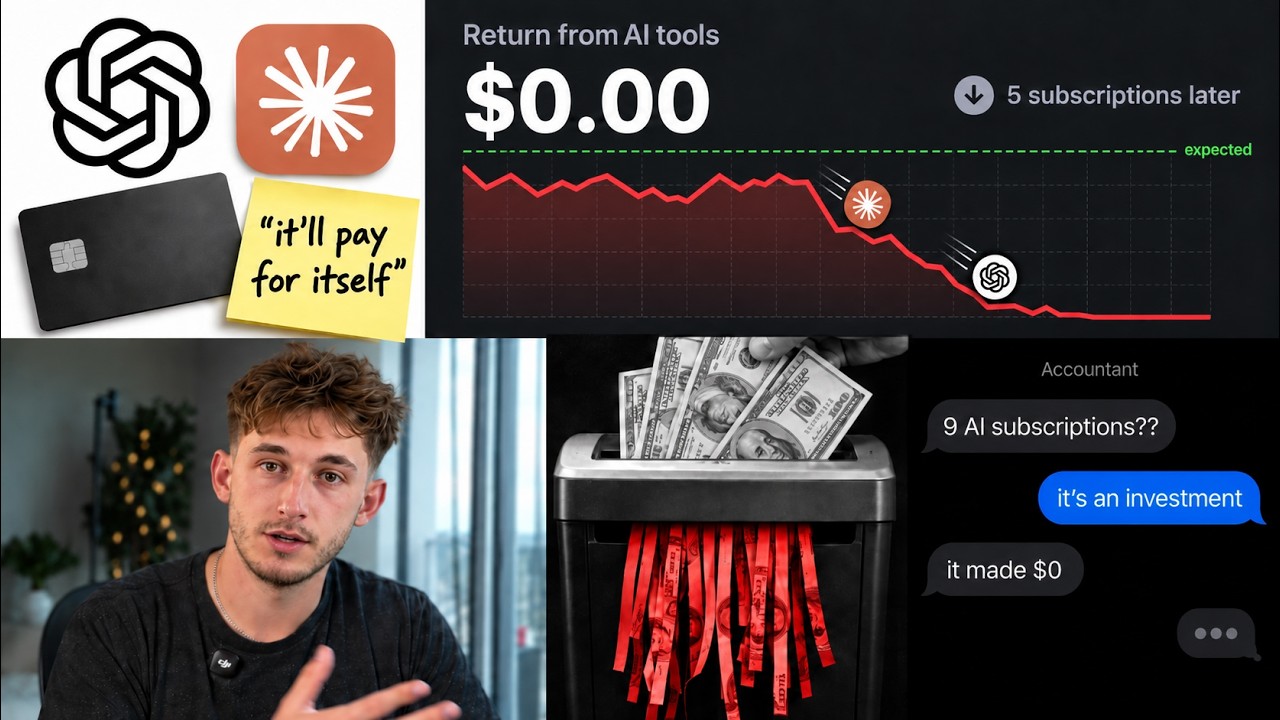
Most businesses treating AI like a shiny new toy are about to flush their investment down the drain. If you are simply buying off-the-shelf tools without a plan, you are likely part of the 95% that fails.
The Simple Version
Imagine hiring a brilliant new employee who has incredible skills but suffers from total amnesia every single morning. You spend the first hour of every day re-explaining the company's rules, the clients' names, and how to do the job. That is exactly how most businesses use AI right now.
Currently, most employees use their own personal ChatGPT or Claude accounts to get work done. While they might be productive individually, none of that knowledge stays within the company. It's like everyone in your office is keeping their own private notebook that no one else can read.
How It Actually Works
To move from a failing pilot to a functional system, you have to change your approach from "buying tools" to "building a system." Successful implementation relies on four specific pillars.
1. The ROI-First Mandate
The biggest mistake is starting with the technology instead of the math. As Nick Puru notes, "If it isn't going to be paying for itself in either hours or money that you can count, it doesn't matter how good the tech... is."
Before a single line of code is written or a subscription is bought, leadership must pick one specific number to move. This could be response time, revenue per person, or hours saved per week. Without this baseline, you will never know if your investment actually worked.
2. Solving the Memory Problem
A major reason for failure is that AI systems don't "learn" the business context. If you have a voice agent on the phone, a chatbot on WhatsApp, and an email assistant, they all need to access the same brain.
Without a centralized knowledge base, you run into the amnesia problem. If your pricing changes, you shouldn't have to update four different tools; you should update one source of truth that all agents read from.
3. Integration Over Isolation
AI shouldn't be another tab that employees have to remember to open. If the AI lives in a separate window, people will eventually revert to their old, manual ways of working.
The goal is to put the AI where the work already lives—inside the CRM, the inbox, or the communication platform like Discord or Slack. When the AI drafts a reply directly in the thread, it becomes part of the natural workflow rather than an extra chore.
Technical Deep Dive
From an architectural standpoint, the transition from "AI tools" to an "AI Operating System" requires moving away from consumer-grade prompting toward integrated data pipelines and human-in-the-loop (HITL) patterns.
The Fragmentation Trap
In many organizations, the current state is a collection of disconnected API calls and individual browser sessions. This creates a massive data silo problem. When an employee uses a personal ChatGPT account, the proprietary context of your business—your tone, your specific product nuances, and your customer history—stays trapped in that individual's session history.
For context, this is the difference between stateless interactions (where every prompt is a fresh start) and stateful systems (where the AI has access to a persistent memory). To build a professional system, you need a stateful architecture powered by a centralized vector database or a unified knowledge base.
Building Robust Workflows
A common technical hurdle is "brittle" automation. Puru mentions a real-world example where an automation for an accounting firm kept breaking because of QuickBooks' mandatory two-factor authentication (2FA). A demo might look seamless, but real-world production environments are messy.
To solve this, developers must implement:
- Validation Layers: Instead of letting an agent book an appointment directly, the system should pass the proposed action through a validation script that checks real-time availability.
- Human-in-the-Loop (HITL): For high-stakes tasks, like drafting legal replies or medical communications, the architecture should follow a "Draft-Review-Send" pattern. The AI performs the heavy lifting of the draft, but a human acts as the final gatekeeper.
- Kill Switches: Every automated system needs a manual override. If an agent begins hallucinating or looping, a staff member must be able to immediately take control of the conversation.
Why This Matters
The window of opportunity for small and mid-sized businesses is uniquely wide. While large enterprises often take 9 months or more to move from a pilot to a production-ready AI system, smaller companies can achieve this in as little as 90 days.
By focusing on high-frequency, high-value tasks—like qualifying inbound leads or managing scheduling—businesses can see immediate, measurable returns. This isn't about replacing your team; it's about removing the repetitive, low-value work that prevents them from focusing on high-level strategy.
If you can successfully implement three meaningful workflows in 90 days, you aren't just using AI; you are building an AI-native operation that scales without proportional increases in headcount.