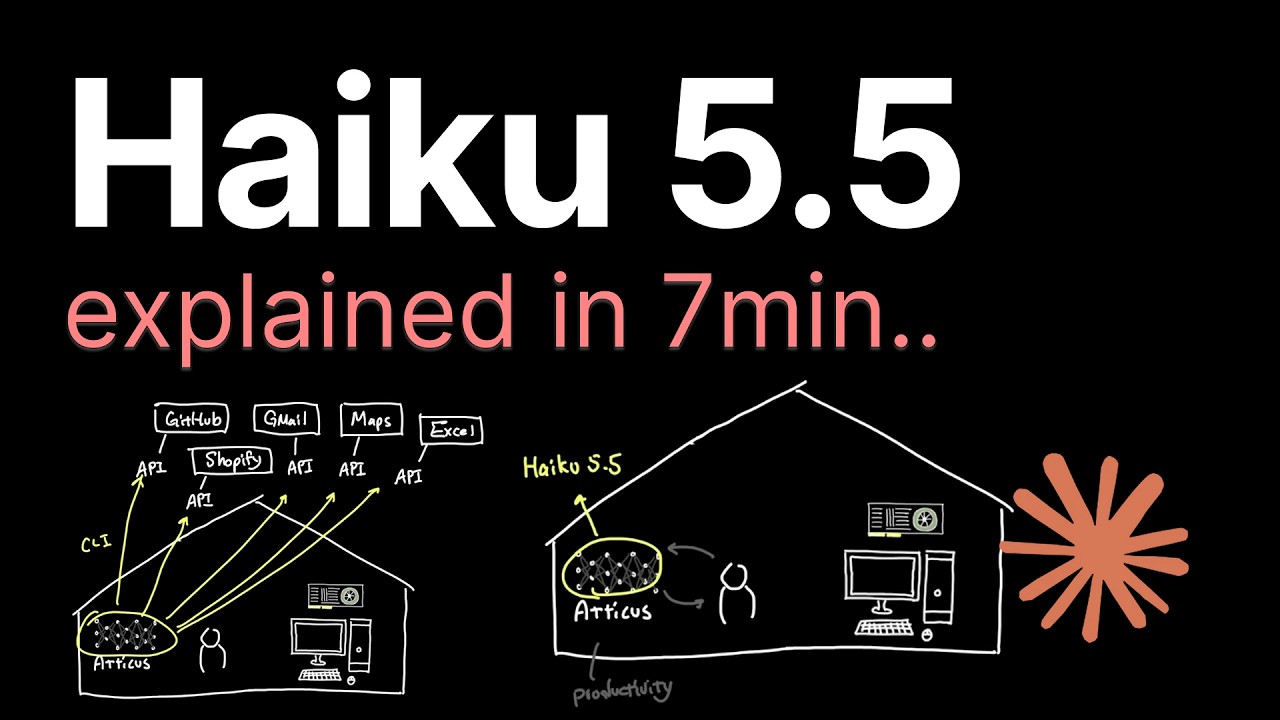
The era of massive, expensive LLMs is being challenged by a new breed of 'efficient intelligence' designed to live in the background of your daily life.
The Simple Version
Imagine you have two types of assistants. One is a world-class professor who is incredibly smart but charges $500 an hour to answer even the simplest questions. The other is a very bright, capable intern who costs only a few cents to keep on call all day.
While the professor (like GPT-6 Luna) is better for complex research, the intern (Haiku 5.5) is perfect for the thousands of tiny, repetitive tasks you face every day. You wouldn't call the professor to change your Excel theme to dark mode, but the intern can do it easily and cheaply.
Haiku 5.5 is designed to sit in this 'intern' quadrant—providing enough intelligence to actually be useful while being cheap enough that you don't have to think twice about every single interaction.
How It Actually Works
The Two-Tiered Pricing Model
Anthropic has implemented a specific pricing structure to incentivize efficient usage. For tasks under 100,000 tokens, the cost is a mere 10 cents per million input tokens. However, once you cross that threshold, the price increases fivefold.
As Caleb Writes Code notes, even though Haiku is more expensive than GPT-6 Luna (which costs roughly 7 cents per million), the difference is often negligible. As he puts it, "Sort of like paying 21 cents to get the job done through Haiku instead of 7 cents for GPT-6 Luna."
Computer Use and OSWorld
What makes Haiku 5.5 different from a standard chatbot is its ability to 'see' and 'act' on your computer. It isn't just predicting text; it is interacting with a graphical user interface (GUI).
This capability is measured using the OSWorld 2.1 benchmark. This benchmark tests how well a model can navigate an operating system to complete long-range tasks, such as formatting a slideshow or booking a trip via a browser.
Haiku 5.5 achieved a score of 72.4% on the OSWorld benchmark. This involves the model receiving screenshots of the desktop, processing the visual information, and deciding on the next action—like moving a mouse or typing—until the goal is met.
Technical Deep Dive
The core technical breakthrough discussed is the ability to push the intelligence-to-cost ratio. In the LLM landscape, there is usually a strict trade-off: higher intelligence requires more parameters and more compute, which drives up latency and cost. Anthropic is attempting to move the 'Pareto frontier'—the limit of what is possible in terms of performance vs. cost.
For an agent to work effectively, it needs more than just reasoning; it needs low-latency vision-action loops. When an agent like 'Atticus' (the personal assistant demonstrated in the video) interacts with a computer, it works through a cycle:
- Input: The system captures a screenshot of the current OS state (e.g., a VS Code window).
- Reasoning: The model (Haiku 5.5) processes the screenshot and the user's voice command.
- Action: The model outputs specific UI actions (click, type, scroll).
- Feedback: The system executes the action and feeds a new screenshot back to the model.
This cycle must be incredibly fast to feel natural. While Haiku 5.5 can generate tokens at 173 tokens per second, the video highlights that complex tasks—like filtering a website—can still take significant time (around 33 seconds for one specific task) due to the multi-step nature of visual reasoning and the high resolution of modern displays (like 4K monitors).
Furthermore, the cost-efficiency of Haiku 5.5 makes it a viable alternative to local hosting. For developers in regions with high electricity costs, such as Michigan at $0.23 per kWh, running a massive local model on an RTX 5090 might actually be more expensive than calling the Haiku API for high-volume tasks.
Why This Matters
This shift marks the transition from 'Chatbots' to 'Agents.' We are moving away from a world where we type prompts into a box and toward a world where models live in our operating systems, performing tasks on our behalf.
The availability of models in this 'low-cost/high-intelligence' quadrant enables massive scale. If every interaction costs only $0.001, developers can build autonomous systems that run 24/7 without bankrupting the user or the company.
However, there are still hurdles. As seen in the demonstration where Haiku struggled to complete a complex web filtering task, the intelligence isn't perfect yet. The ability to follow long-range instructions without 'giving up' or making errors in visual interpretation remains the next great frontier for models like Haiku and Luna.