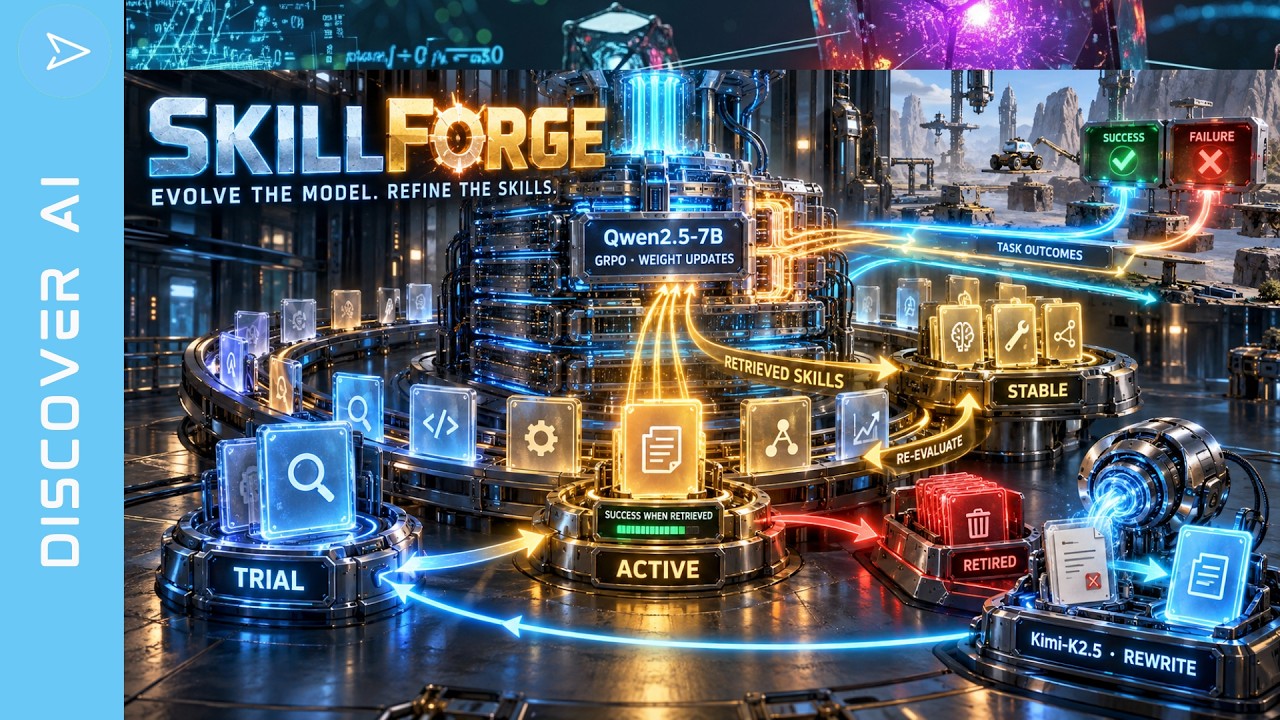
Imagine an AI that doesn't just follow instructions, but actually learns from its mistakes in the real world—and then has the wisdom to delete the bad habits it picked up along the way.
The Simple Version
Most AI agents today are like students with a textbook (their training data) and a notebook (their memory or 'harness'). The problem is that textbooks get outdated, and notebooks often get filled with wrong notes.
If a student believes a lie from the textbook and writes that lie in their notebook, they enter a 'feedback loop of failure.' The bad note reinforces the bad belief, and the AI starts making the same mistake over and over.
SkillForge fixes this by allowing the chef to update both their intuition (the model weights) and the recipe book (the skill library) simultaneously. Crucially, it adds a 'trash can'—a retirement process—to throw away recipes that no longer work as the chef becomes more skilled.
How It Actually Works
The system splits the AI's intelligence into two distinct components: parametric knowledge (the weights inside the LLM) and procedural memory (the harness containing skill markdown files).
The Harness and the Skill Lifecycle
The 'harness' is a collection of markdown files providing specific instructions, examples, and applicability conditions. Instead of keeping every skill forever, SkillForge implements a dynamic lifecycle to ensure only high-quality guidance reaches the agent.
Skills move through a pipeline: Trial (newly observed behaviors), Active (being tested), Rewritten (optimized), Stable (proven successful), and finally Retired. As the speaker notes, skills are not accepted until they are "battle tested" for a specific task; if a skill's success rate drops too low—for instance, to 20%—it is promptly retired.
The Coupled Learning Loop
The most critical insight of SkillForge is that the LLM and the skill library form a coupled learning system. When the system updates the skill library, it changes the instructions provided in the LLM's context window.
This change in context alters the LLM's behavior, which in turn changes the training trajectories and rewards the LLM receives during reinforcement learning. This creates a complex, interwoven experience where the agent's internal growth changes the usefulness of its external tools.
The Danger of Cascading Errors
Without this co-evolution, agents suffer from 'cascading errors.' This happens when an internal bias leads to a misinterpretation of an event, which is then stored as a 'skill' that guides future actions.
The speaker describes this as a "cycle of hell" where distorted interpretations and outdated skills reinforce one another, leading to total system chaos. SkillForge breaks this cycle by treating skills as temporal objects that must be constantly re-evaluated.
Technical Deep Dive
SkillForge achieves its results by combining internal weight updates with external library management, utilizing Qwen 2.5-7B as the primary agent LLM.
The Dual Learning Mechanism
Internal optimization is handled via two methods. First, Supervised Fine-Tuning (SFT) is used to learn from successful demonstrations. Second, Group Relative Policy Optimization (GRPO) aligns the model using reward functions based on task outcomes.
For context, GRPO is a reinforcement learning technique—popularized by DeepSeek-V3—that removes the need for a separate critic (value) model. Instead, it estimates the baseline reward by averaging multiple sampled outputs from the same prompt, which significantly reduces VRAM usage and computational overhead.
Teacher-Student Distillation
To refine the external library, SkillForge uses a teacher-student architecture featuring Kimi K2.5 as the teacher. When a skill needs optimization, the system sends the current skill, task statistics, and examples of failed tasks to Kimi K2.5.
Kimi doesn't necessarily write perfect code, but it proposes revised instructions and refined procedural steps. These are placed in a sandbox environment and must meet a high success threshold before being promoted to the stable skill bank.
Non-Stationary Fitness and Benchmarks
A key technical delta in SkillForge is the recognition that skill fitness is non-stationary. Because the LLM's policy evolves through GRPO, a skill that was helpful at step 1,000 of training might be a hindrance at step 10,000.
The empirical results show that this approach outperforms the previous SkillRL framework. Specifically, SkillForge provided the following improvements: WebShop saw a jump of 5.7 percentage points (moving from 72% to 78%), AlphaWorld increased by 2.5 percentage points, and Search Augmented Q&A rose by 1.9 percentage points.
Why This Matters
The AI industry often focuses on scaling model size, but SkillForge demonstrates that architectural agility is often more valuable. By separating the 'brain' (weights) from the 'manual' (skills), we can create agents that adapt to new environments in real-time without expensive full-model retraining.
The introduction of 'skill retirement' marks a shift in how we think about memory. In traditional RAG (Retrieval-Augmented Generation) systems, the goal is usually to add more data. SkillForge recognizes that for an AI to truly evolve, it must be able to unlearn and prune the 'training wheels' that it no longer needs.
However, it is important to note that this system is currently based on empirical improvements rather than a formal mathematical proof of convergence. As the speaker admits, the 'complete mathematical theory' is still missing, leaving a significant opportunity for future research into reliable self-correction.