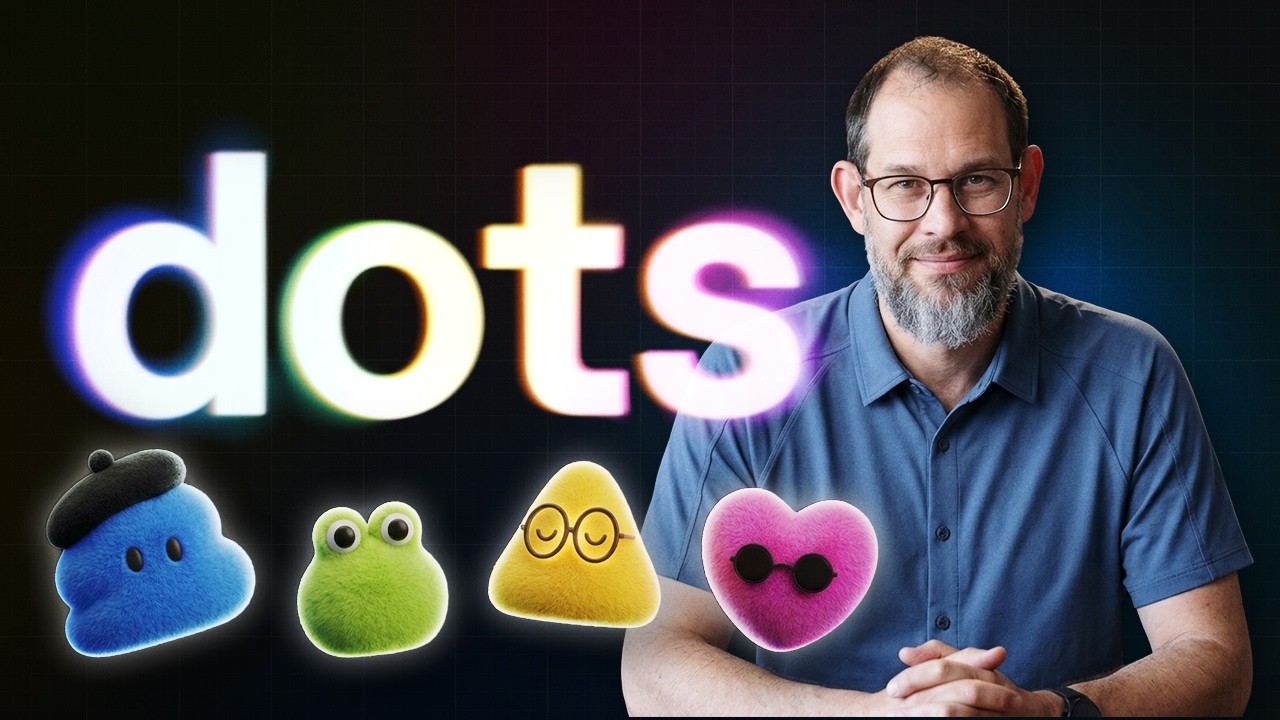
The era of the 'chatbot' is officially ending, and the era of the 'agent' has arrived. OpenAI just upped the ante with a suite of tools designed to move AI from a tab in your browser to a permanent employee in your digital office.
The Simple Version
Imagine you have a Chief of Staff who never sleeps, remembers every project detail, and has their own laptop to get work done while you're offline. That is essentially what Dots are.
Unlike a standard AI chat where you ask a question and get an answer, a Dot is an agent you give ongoing responsibilities to. It doesn't just suggest a calendar fix; it actually goes in and cleans up your 'zombie meetings' or spots conflicts between your DMV appointment and your travel plans.
The real skill of the future isn't just prompting; it's AI delegation. It's about knowing which 'employee' to assign to which task—whether that's a powerhouse model for complex logic or an efficiency model for chewing through massive data sets.
How It Actually Works
The Anatomy of a Dot
A Dot isn't just a prompt; it's a bundle of three critical capabilities: a computer, a memory, and the ability to perform background work. This allows the agent to keep operating after you log off.
These agents run on the frontier GPT-6 Astra model, ensuring they have the highest level of reasoning available. They can be accessed across multiple platforms, including the web, mobile, Slack, and Codeex.
OpenAI is also previewing Specialist Dots designed for organizational workflows. These are being integrated with Microsoft's Agent 365 controls, allowing OpenAI to compete for employee work while fitting into the management systems companies already use.
The Model Hierarchy: Astra vs. Sol
While Astra is the high-intelligence powerhouse, OpenAI launched GPT-6.1 Sol as an efficiency engine. Sol is designed for demanding work that doesn't require the full Astra overhead, making it ideal for tasks with high context tokens.
According to the release, Sol approaches Astra's performance on selected evaluations but at a fifth of Astra's standard input and output token prices. This allows power users to perform complex research and coding tasks without draining their weekly plan allowance.
Space and Pages: The AI Workspace
OpenAI is moving directly into Microsoft Office territory with Space and Pages. Space is a shared environment where humans and AI collaborate in real-time on live documents called Pages.
As Nate B Jones puts it, "They are building the future Microsoft Office competitor. That's what they're doing. They are going after that same space of collaborative work." This setup allows a product lead to explain a feature delay in a Space, which the AI then uses to proactively update sales decks and announcement materials.
Technical Deep Dive
From an architectural perspective, Dots represent a shift toward Agentic Workflows. Instead of a linear request-response cycle, Dots utilize a loop of planning, tool execution (via their cloud computer), and observation.
The 'cloud computer' is essentially a sandboxed Virtual Machine (VM) that allows the agent to interact with software environments without risking the user's local machine. This is similar to 'computer use' capabilities where the AI can navigate a GUI or execute CLI commands.
The Decisions API and Classification
OpenAI also introduced the Decisions API, which uses the Luna model to perform high-speed classification. It allows developers to define a set of possible answers, and the AI chooses the correct one, such as categorizing a request as 'pricing' or 'release date'.
This targets a 'classification-shaped' business problem. For context, this is similar to the Jev model system, which focuses on constrained decisions to enable massive automation without the unpredictability of open-ended generation.
The 'Bring Your Own AI' Plugin Model
The new plugin extensions allow developers to build interactive tooling that integrates directly into ChatGPT. A critical architectural shift here is the 'Log in with ChatGPT' feature.
This enables a Bring Your Own AI (BYOAI) model. Instead of the developer paying for tokens to serve the user, the user brings their own ChatGPT subscription to the service. This removes the burden of token fraud and pricing from the entrepreneur and places it on the user's existing plan.
Why This Matters
The battle for the AI agent market is splitting into Personal Utility and Professional Context. While Meta's Muse (with over 5 million downloads) focuses on 'life admin' like dentist appointments, OpenAI is positioning Dots specifically for the workplace.
This creates a strategic tension with Microsoft. While they are partners, Space and Pages are direct challenges to Word and Teams. For enterprises, the choice will be between the 'least risky' option (Microsoft) and the 'frontier intelligence' option (OpenAI).
Furthermore, we are seeing a massive gap between intelligence and agency. As models like Astra and Fable 5.1 become capable of synthesizing hundreds of pages of transcripts into novel insights, the bottleneck is no longer the AI's ability, but the human's ambition to assign it the right job.
The pricing tiers—$100, $200, and $500—signal that AI is moving from a consumer subscription to a professional investment. With the $500 plan offering 8x faster token generation in Codeex, OpenAI is betting that high-agency builders will pay a premium for raw speed and outcomes over simple activity.