Most developers can build a basic AI chatbot in an afternoon, but building a production-grade AI agent is a different beast entirely. There is a massive gap between a demo that works once and a system that handles thousands of real-world transactions without hallucinating or crashing.
The Simple Version
At its heart, an AI agent isn't just an LLM; it's an LLM inside a loop. A standard LLM is like a student answering a test question—it sees the prompt, gives an answer, and stops. An agent, however, is like a pilot flying a plane.
When a pilot hits turbulence, they don't just stop flying; they observe the instruments, make a correction, check the results, and adjust again. This cycle of decide, act, observe, and then decide again is what transforms a static model into an autonomous agent.
How It Actually Works
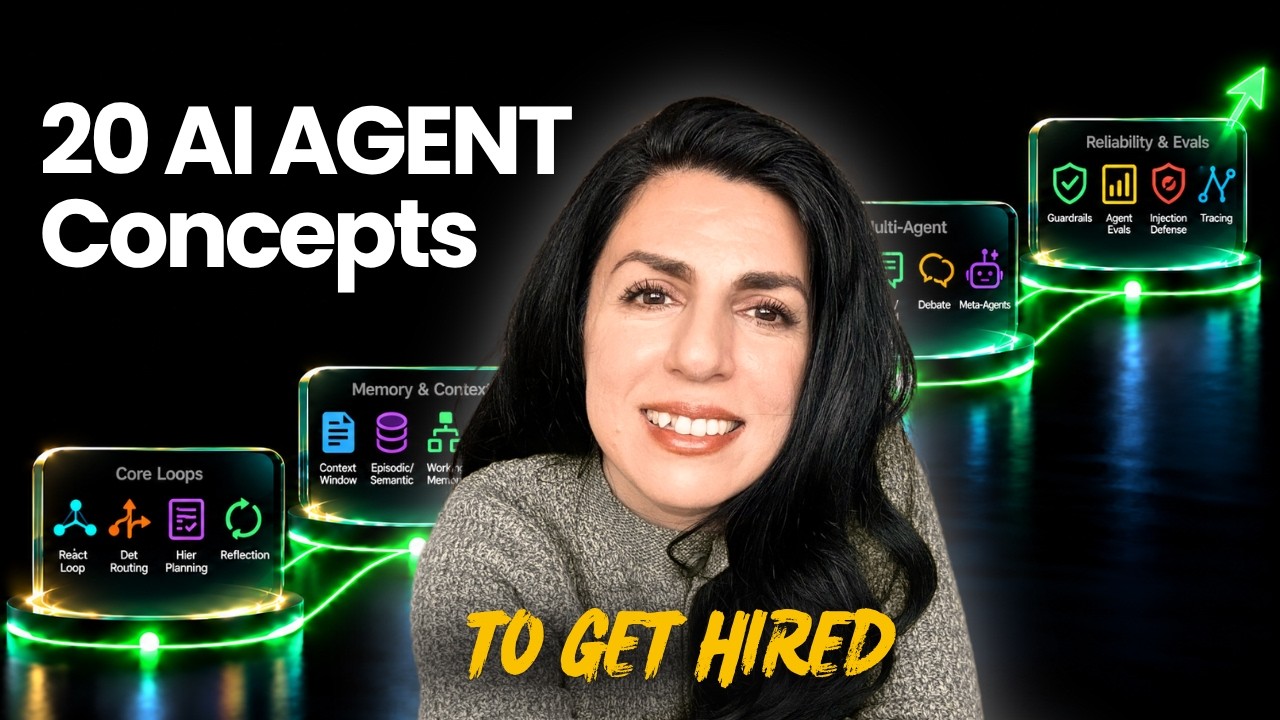
Building a production agent requires moving through five layers of architectural complexity. It starts with basic reasoning and ends with industrial-grade security.
Level 1: Core Reasoning & Loops
The foundation of any agent is the agent loop. Dr. Miradi recommends using LangGraph to build these as small graphs where nodes represent the agent and conditional nodes determine if the process should continue or end.
A critical distinction here is Deterministic vs. Probabilistic decisions. While LLMs are probabilistic (they predict the next token and can vary their answers), production systems need hard rules. For example, if a policy requires human approval for transactions over 10,000, that should be a hard-coded 'if' statement, not an LLM's guess.
Level 2: Context & Memory
Context engineering is about avoiding "noise." Even with huge context windows, stuffing everything into the prompt overwhelms the model. Dr. Miradi suggests Google ADK for context budgeting and compaction to keep only what matters.
Memory is further split into two types: Semantic Memory (general knowledge, like a flight manual) and Episodic Memory (what happened recently, like a pilot's logbook). Tools like Mem0 and Zep help manage these different streams.
For real-time coordination, agents need a Shared Working State—a digital blackboard where all agents can see current statuses. Redis is the tool of choice here due to its extreme speed, which is vital for high-stakes environments like the Alsmere flower auctions.
Level 3: Tools & Human Control
Giving an agent the ability to run code is dangerous. Sandbox Execution via tools like E2B creates an isolated environment where generated code can run without risking the host system's credentials or files.
To prevent agent confusion, Dynamic Tool Retrieval is used. Instead of showing the agent 100 tools at once, the OpenAI SDK can hide tool definitions until a search determines they are actually relevant to the current task.
Level 4: Multi-Agent Orchestration
Complex tasks require a team of specialists and one manager. This Orchestrator agent doesn't do the grunt work but assigns tools to researchers and testers to ensure the workflow remains optimal.
To keep these agents from talking in vague circles, Structured Communication is required. Rather than casual chat, agents should pass structured fields for tasks, status, and errors, similar to how air traffic controllers use strict codes to communicate with pilots.
Level 5: Production & Evaluation
The final layer is about reliability. Deterministic Guardrails (via PydanticAI) ensure the model's output matches the required format before it hits the backend. Trajectory Evaluation using DeepEval focuses on the process—how the agent reached the answer—rather than just the final result.
Technical Deep Dive
From an architectural perspective, the transition from a 'chain' to a 'graph' is the most significant shift in agent engineering. Traditional LLM chains (like basic LangChain) are Directed Acyclic Graphs (DAGs), meaning they move in one direction. However, production agents require cycles—the ability to loop back to a previous state for self-correction.
This is where LangGraph excels by allowing stateful, cyclic graphs. When an agent performs a 'reflection' loop, it essentially creates a feedback mechanism where a 'Critic' agent evaluates the output and sends it back to the 'Generator' node if it fails validation. This mimics the Generative Adversarial Network (GAN) architecture, where a generator and discriminator compete to improve the final output quality.
Another technical hurdle is Idempotency. In distributed systems, a network glitch might cause an agent to retry a request. If that request is a payment refund, you cannot simply 'retry' it, or the user gets paid twice. Implementing idempotency keys (a practice common in the Stripe API) ensures that the backend recognizes a retry as the same transaction, not a new one.
Finally, observability in agents cannot rely on simple print statements. Because agents involve asynchronous tool calls and multi-agent hops, Distributed Tracing via OpenTelemetry is mandatory. By using 'spans,' engineers can trace a single user request across multiple sub-agents and tool executions to find exactly where latency or a hallucination occurred.
Why This Matters
The shift toward 'Agentic AI' means we are moving from LLMs as consultants to LLMs as employees. When an AI has the authority to move money, delete files, or communicate with customers, the cost of failure skyrockets. Understanding these 20 fundamentals is the difference between a toy and a tool.
By implementing sandboxing, trajectory evals, and deterministic guardrails, companies can finally move past the 'prompt engineering' phase and into actual software engineering. This allows for the creation of systems that are not just 'smart,' but predictable and secure enough for enterprise deployment.