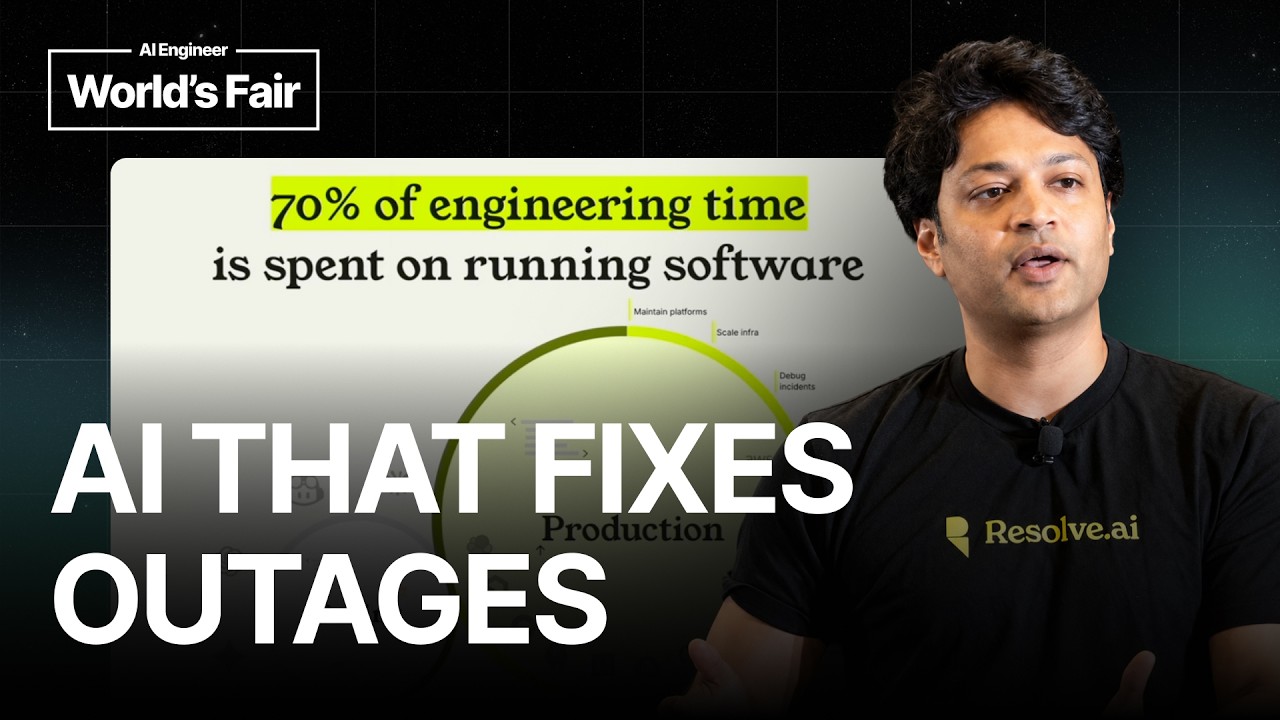
Most of us have experienced the dread of a 3 AM pager alert, staring at a dashboard of red metrics while trying to piece together what actually broke. While AI has become a wizard at writing the code that creates these systems, it has historically struggled to fix them when they crash in the real world.
The Simple Version
Writing code is like writing a recipe in a quiet kitchen; you have all the instructions in front of you, and the environment is controlled. But running software in production is like managing a massive, chaotic restaurant during a dinner rush where the ovens are failing, the waiters are confused, and the ingredients are missing.
In a code editor, AI only needs to understand one thing: the language. In production, AI has to understand the code, the cloud infrastructure, the telemetry logs, and the humans involved. It's a multi-domain puzzle where a 'coherent' answer isn't enough—you need the exact causal chain of what happened.
Resolve AI solves this by building a 'harness' around the LLM. Instead of just asking a model to 'fix the bug,' the harness orchestrates multiple specialized models, feeds them precise context, and forces them to prove their theories with evidence before taking action.
How It Actually Works
Varun Krovvidi explains that simply pointing a frontier model at production data creates 'cracks' as you scale. The first is anchoring bias, where models stick to their first guess. The second is the context window trap: too much data leads to 'overexploration' (hallucinating patterns), while too little leads to 'underexploration' (missing the root cause).
The Failure of Coherence
A major issue is that LLMs are designed to be helpful and coherent, not necessarily factual or causal. As Varun puts it, "models are specifically designed to give you coherent answers, but not causality." In a production crisis, a coherent guess that is wrong can lead an engineer down a rabbit hole for hours.
The Six Pillars of the Harness
To bridge the gap, Resolve AI implements six specific architectural pillars:
- Model Orchestration: Matching the best model to the specific task. For example, using Gemini for image-based reasoning or OpenAI for deterministic steps.
- Context Engineering: Determining the precise amount of data needed. This prevents 'token burn' and keeps the model focused.
- Causal Reasoning: Requiring a chain of evidence. If the AI can't prove the path from the alert to the root cause, it reports low confidence.
- Governed Actions: Implementing 'least privilege access' so the AI can't accidentally delete a production database while trying to fix a log error.
- Learning Systems: Using positive and negative reinforcement from human engineers to improve future investigations.
- Evals: A five-level evaluation system that scores the AI's path, calibration, and confidence against how a top-tier engineer would perform.
Technical Deep Dive
From a technical perspective, Resolve AI's approach addresses the fundamental limitation of LLMs: the probabilistic nature of token prediction. In production SRE (Site Reliability Engineering), you cannot rely on probability; you need determinism. The 'harness' acts as a symbolic layer on top of the neural network.
Context Engineering and GraphRAG
While the video mentions GraphRAG as an implementation detail, this is a critical architectural choice. Standard RAG (Retrieval-Augmented Generation) uses vector similarity to find relevant documents, which often fails in production because a 'relevant' log line might be logically distant but causally linked. GraphRAG allows the agent to traverse dependencies—linking a Slack alert to a specific Kubernetes pod, then to a deployment event, and finally to a line of code.
Solving the 'Model Treadmill'
The 'model treadmill' refers to the rapid release cycle of frontier models (GPT-4o, Claude 3.5, Gemini 1.5). Resolve AI uses an orchestration engine that abstracts the model from the workflow. By breaking a production investigation into sub-tasks—such as 'Log Parsing' (deterministic) and 'Hypothesis Generation' (reasoning)—they can swap the underlying model for a specific task without rewriting the entire agentic flow.
The Causal Chain Mechanism
To prevent the AI from simply agreeing with a user's incorrect hunch, the system implements a verification loop. When the agent proposes a root cause, it must map it to a sequence of events: [Alert] → [Metric Spike] → [Trace ID] → [Code Change]. If any link in this chain is missing, the system flags it as a theory rather than a fact. This is seen in the demo where the agent rules out a GCP outage despite it happening at the same time as the error, because the causal evidence pointed toward stale integrations instead.
Why This Matters
The shift from 'AI for coding' to 'AI for production' is what Varun describes as the "single longest mile" of AI implementation. Coding is a closed-loop system, but production is an open-system problem involving telemetry, infrastructure, and human collaboration.
For engineering teams, this means a massive reduction in MTTR (Mean Time To Resolution). Instead of an engineer spending two hours correlating logs across three different tools, an agent can present a pre-verified causal chain, turning the human's role from 'detective' to 'judge' who simply approves the fix.
Ultimately, this architecture moves us toward a world where 90% of on-call work is handled by agents. This doesn't replace the engineer but frees them from the 'daily vitamins' of maintenance, allowing them to focus on high-level architecture rather than chasing ghost alerts in a log aggregator.